Across the Northeast, this time of year is known in local Indigenous traditions as the Nikommo Gift Giving Moon, a season of gratitude, reflection, and reciprocity. In other traditions the Solstice is marked by great fires and sharing of light, feasting and joy for the returning days of sun, a time of building excitement for the year to come. It is a time when communities gather to offer thanks for what has been harvested, to share what we have with those who need it, and to prepare ourselves spiritually and materially for the rest of the winter ahead. For me, this season carries a deeper resonance. Turtle Island Community Capital was an idea that lived in my notebook and heart for a long time and it has now completed its first full year as a Native-led financial intermediary serving the Indigenous nations and communities of the Northeast and Mid-Atlantic. And this month, returning to Washington, DC at the Native CDFI Network Annual Conference, I feel the weight of that journey in a new way.
How We Began
TICC was not born from institutional power, federal subsidy or inherited wealth. It began with:
• Financial capital bootstrapped from my personal savings and from cashing out my retirement, investing my future in the innovation and strength of the community
And, perhaps most importantly, it began with:
• Time capital, offered by my partners and family with patience and generosity during a year when we welcomed new children into the world. They made room for the late nights, the travel, the emotional labor, and the weight of building something meant to last for generations. This is the kind of capital rarely acknowledged in financial statements, yet it is the foundation of everything we have built.
What We’ve Accomplished Together
As we release our First-Year Reflection Report, I am filled with gratitude for our community and the support that carried us to this moment. Highlights include:
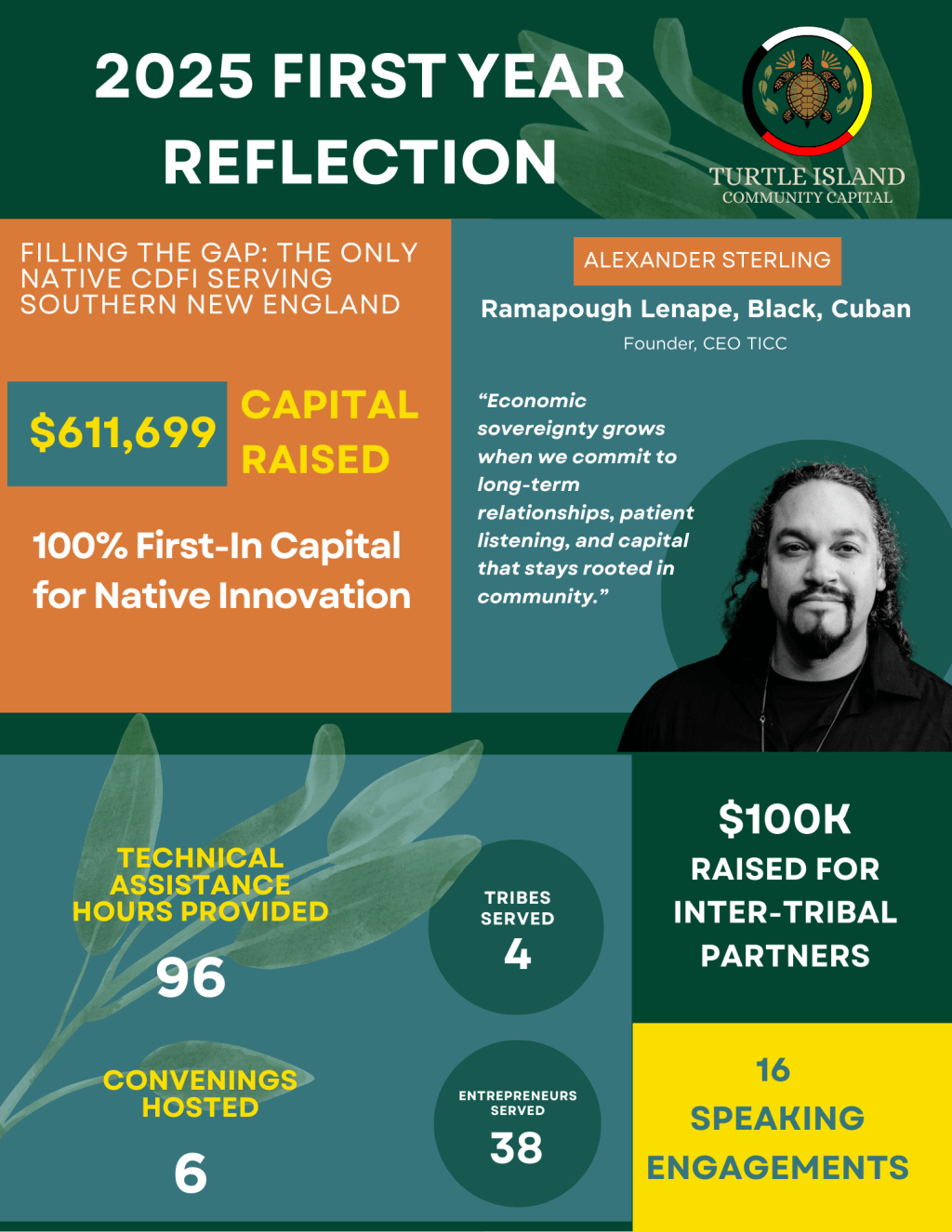
📈 $611,699 raised—entirely from Native-aligned, mission-driven partners
📊 96 hours of technical assistance delivered to entrepreneurs
🧑🤝🧑 38 Indigenous entrepreneurs supported
🪶 4 tribal nations engaged in economic development
🤝 $100,000 raised for inter-tribal partners
🎤 16 speaking engagements amplifying Native economic sovereignty
📣 6 Native Impact Night convenings bringing together over 120 Indigenous innovators, artists, and allies
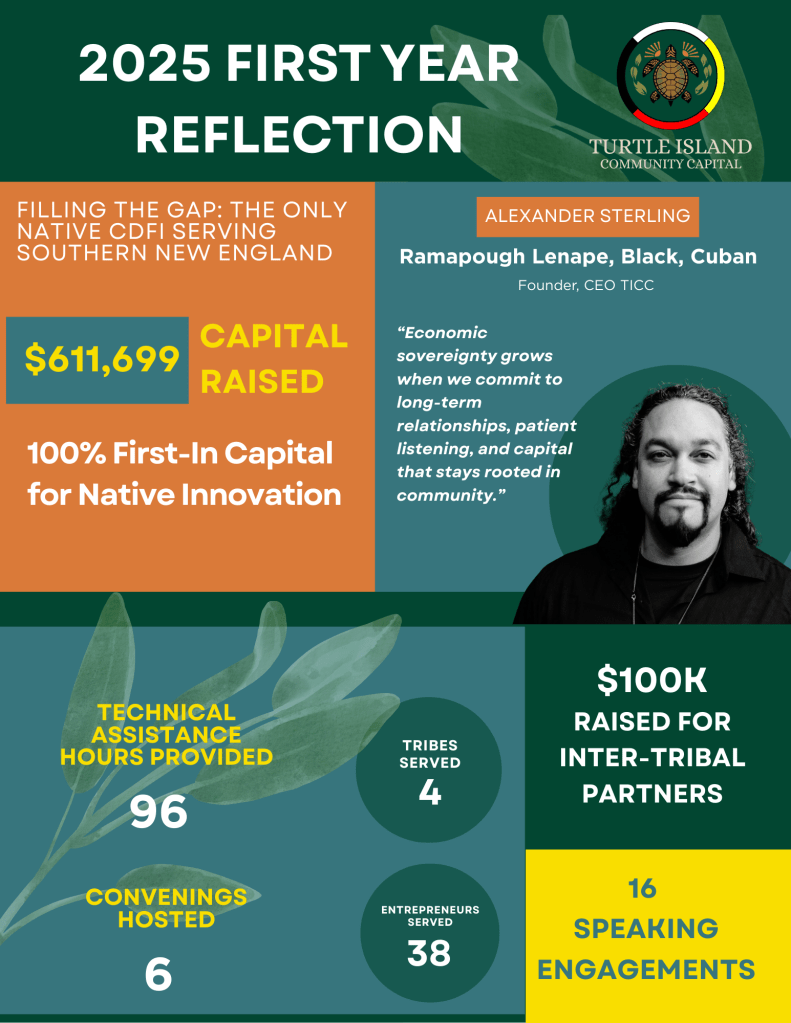
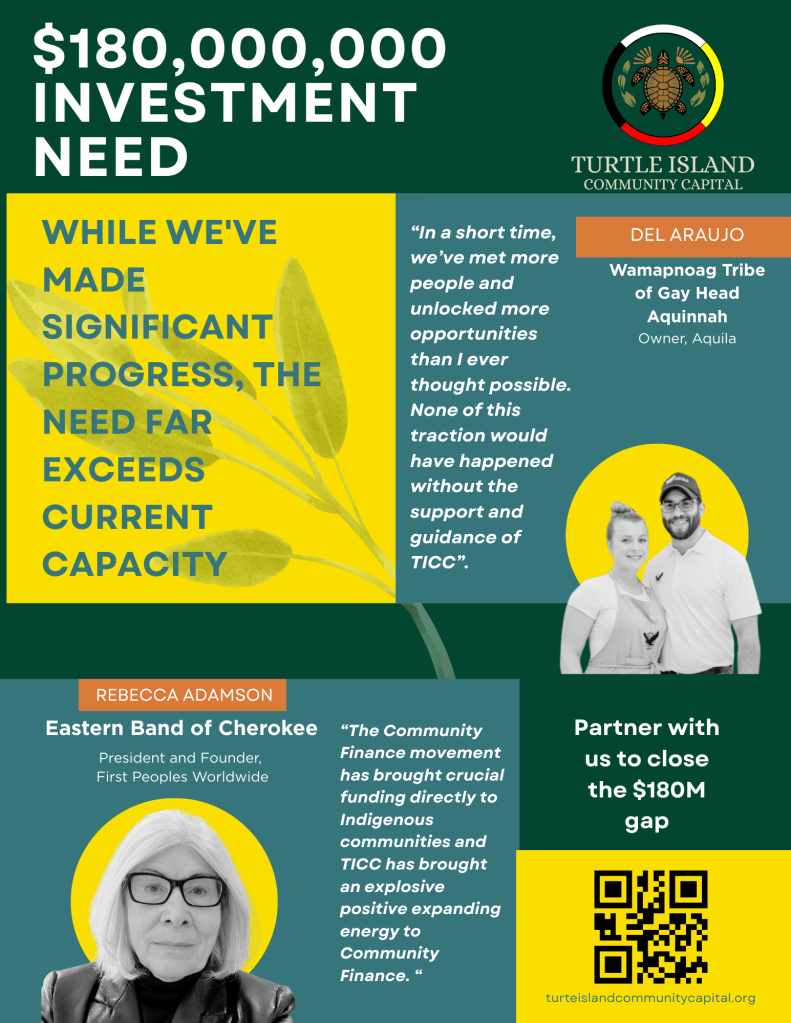
These numbers tell a story of early momentum, but they point to something larger. Our region holds a documented (so far) $180 million investment need across Native businesses, cultural institutions, food sovereignty projects, and clean energy infrastructure.
Giving as a Political Act, a Cultural Act, and a Community Act
During the Native CDFI Network Conference in DC, I am reminded again that our work is not just about capital deployment. It is about repairing systems of reciprocity that were intentionally broken.
Potlatching, Nikommo, giveaway ceremonies—they were outlawed precisely because they upheld Indigenous values that run counter to extraction:
• everyone in the circle eats• abundance is shared• leaders give the most• community well-being is the measure of success
In this sense, giving is governance, culture, and economic design. And as we prepare for a new year, this is the principle guiding our work: to build financial systems that look like an economy of care and regeneration, that put goodness into the world and into the work.
I think often about my Cuban Abuela and Abuelo and the way their home worked. There was always someone stopping by, always a seat being pulled out from the table, always food in some stage of preparation. You could smell it before you even reached the door, the fresh chicharon and rice and platano maduro. They didn’t talk about generosity or Community, they lived it. If you showed up, you were fed. If you needed something, they found a way to give it. No one left that house without feeling seen and cared for. That way of welcoming people, of making space without hesitation, shaped how I understand service. It taught me that real community is built through steady, everyday acts of showing up for one another, not grand gestures.
I also carry the memory of my grandmother, Roberta Jean Fields, who sat on council with the Ramapough Mountain Indians and spent her life pulling people together in ways that felt simple but held real meaning. She taught me how to bake an apple pie in a kitchen that always felt like the center of something larger than itself. Every holiday she found a way to gather family to our home in Patterson, New Jersey. Those meals weren’t just holiday traditions for me, they were community anchors. When she passed, those gatherings faded, and the loss wasn’t just hers. It was the loss of a place where people knew they were welcome, where I knew I belonged. That experience stayed with me. It showed me what disappears when the anchor of a community is gone, and it shaped my commitment to building institutions that can hold that role sustainably by being steady, consistent, rooted. The kind of place where people can return and know there will always be a seat waiting for them.
It’s the same principle at the heart of how we build at Turtle Island Community Capital: create space, offer what you have, and make sure people leave stronger than they arrived.
If this work moves you, consider supporting TICC during this season of giving:
http://www.turtleislandcommunitycapital.org/donate
Your support doesn’t just fund our work. It multiplies it. Every dollar we receive allows us to train more entrepreneurs, stand up more Native-led projects, open more doors for tribal nations, and build financial systems that reach far beyond any one individual or family. When you invest in TICC, you make it possible for us to support dozens more people who are building businesses, cultural spaces, food systems, and energy solutions for their communities. Your gift sets off a chain reaction that grows well past the point of donation.
As we move into the solstice season, I ask you to stay close to the work that strengthens our communities. Support the organizations building for the long term. Support the leaders creating the conditions for our children and their children to inherit something better than what we were given. When you stand with us, you help accelerate the impact we can deliver and expand the circle of people who benefit from it.
Anushiik, Muchos Gracias. Thank you.
Alexander “Brave Journey” Sterling
CEO, Turtle Island Community Capital
 Turtle Island Community Capital
Leave a comment